

A short definition
Static pressure is the resistance a duct system offers to the air being pushed through it. It is the pressure the air exerts outward against the duct walls, as opposed to the pressure associated with its forward motion.
In North America it is measured in inches of water gauge, written in. wg. Elsewhere it is measured in pascals. One inch of water gauge is approximately 249 pascals.
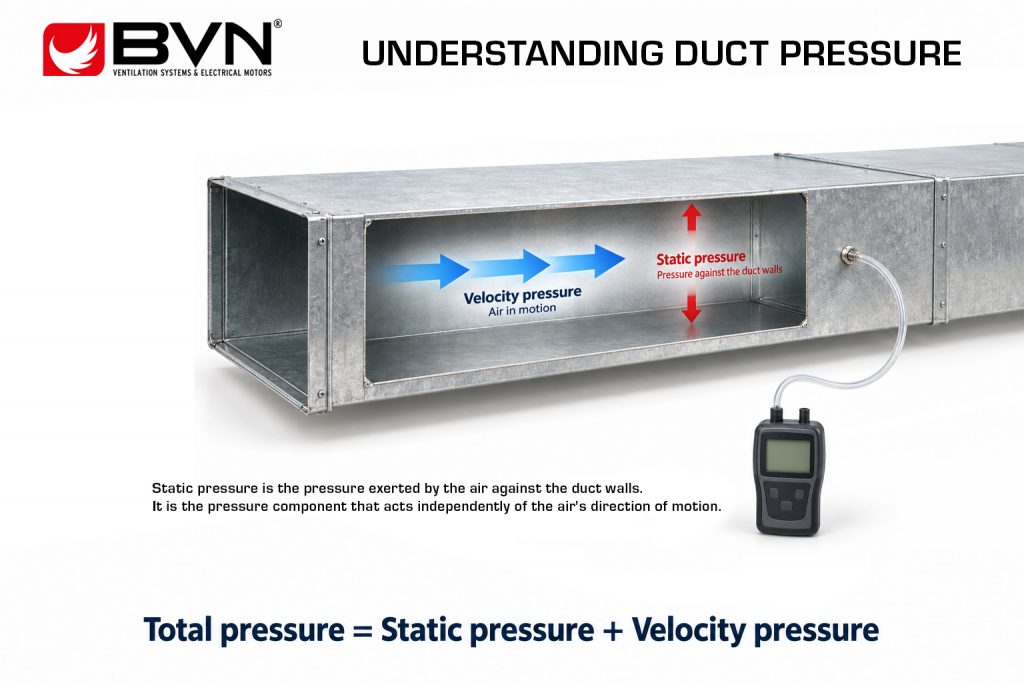
Static, velocity and total pressure
Three related quantities appear in fan and duct calculations.
Static pressure is the outward pressure against the duct wall — the resistance to be overcome.
Velocity pressure is the pressure associated with the air’s motion, and it rises with the square of velocity.
Total pressure is the sum of the two. A fan’s total pressure capability is what it can generate; the external static pressure figure in a catalogue is what remains available to overcome the system after internal losses.
For most selection work, external static pressure is the number that matters.
What creates static pressure in a system
Every component between the fan and the outside contributes.
Straight duct contributes friction, which depends on duct diameter, interior surface, length and air velocity. Narrower duct raises velocity sharply and friction with it.
Fittings contribute more than most people expect. A 90-degree elbow can impose the same resistance as many feet of straight duct. Transitions, tees and boots each add their share.
Filters contribute, and they contribute more as they load. A filter must be counted at its dirty pressure drop.
Dampers, including backdraft dampers that are often forgotten, add resistance. So do grilles, registers and diffusers.
Finally the exterior termination — the roof cap, wall hood or louvre, and any bird screen — adds resistance, and on a small system it can be a surprisingly large share of the total.
Why a CFM rating alone tells you almost nothing
A fan rated at 500 CFM will deliver 500 CFM only at the pressure at which that figure was measured. Catalogue headline numbers are commonly quoted at or near zero static pressure, which is a condition no installed duct system ever presents.
Put the same fan into a system with 0.5 in. wg of resistance and it might deliver 350 CFM. Put it into a system with 1.0 in. wg and it might deliver very little at all.
This is why a fan’s performance is published as a curve rather than a single number, and why any selection request that contains only a CFM figure is incomplete.
How static pressure is measured
In the field, static pressure is measured with a manometer connected to static pressure taps or probes inserted into the duct, perpendicular to the airflow so that velocity does not influence the reading.
Readings are typically taken on both sides of the fan, and the difference between them gives the pressure the fan is developing. Comparing that against the fan curve tells you what airflow the fan is actually delivering — which is often the fastest way to diagnose a system that is not performing.
What this means for fan selection
Static pressure determines the type of fan, not just its size. Systems with low resistance can be served by axial fans. Systems with meaningful resistance need centrifugal fans, because a centrifugal fan holds its airflow far better as pressure rises.
It also determines where on the curve the fan will operate, which in turn affects efficiency, noise and stability. Two fans that both meet a duty point on paper can behave very differently in the building, depending on where that point sits on each curve.
Calculate the pressure. Everything else in fan selection follows from it.
Frequently Asked Questions
What is a normal static pressure for a duct system?
There is no normal value; it depends entirely on the system. Short, wide, straight runs may be well under 0.25 in. wg, while long runs with filters and multiple fittings can exceed 1.0 in. wg.
What is the difference between static pressure and external static pressure?
External static pressure is the portion of the fan’s pressure capability available to overcome the duct system, after internal losses within the unit.
How do I convert inches of water gauge to pascals?
Multiply by approximately 249. One inch of water gauge equals about 249 Pa.
Does duct size affect static pressure?
Strongly. Reducing duct diameter raises air velocity, and friction loss rises with roughly the square of velocity.