

First, the vocabulary
In North America this product goes by several names, and the inconsistency causes real confusion at specification stage.
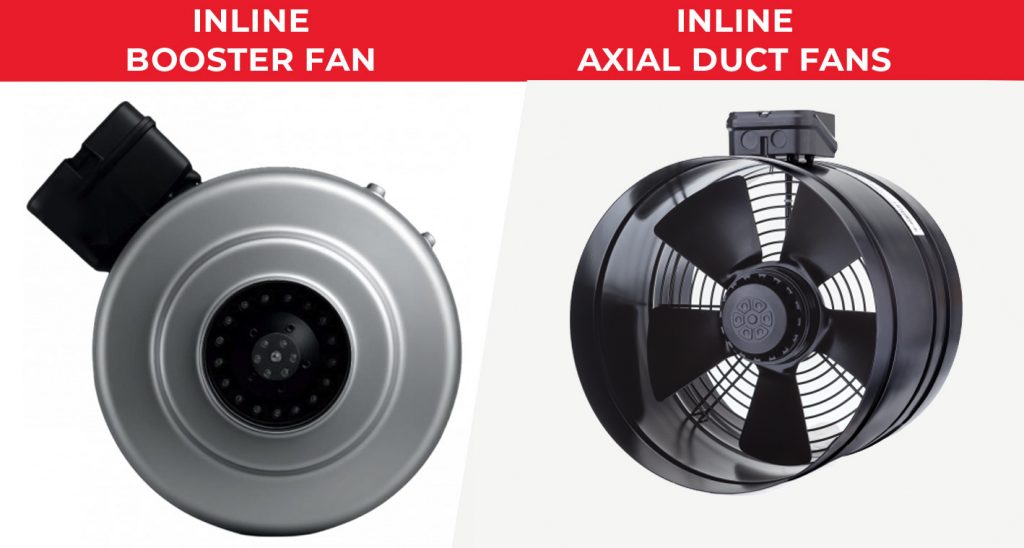
Supply houses and distributors usually file them under inline booster fans, or inline air booster fans. That is the category you will find them under when you go looking. Manufacturers, on the other hand, name the products by impeller type: inline centrifugal fan, or inline axial fan. On a drawing or in a written specification, inline centrifugal is the term you will more often see.
These are not competing names for the same thing. Booster fan describes the job — adding pressure to a duct run that cannot move its required airflow on its own. Centrifugal and axial describe how the fan is built, and that is what determines whether it can actually do that job.
Both types are sold as booster fans. Usually only one of them is the right answer for a given duct run, and that is what the rest of this page is about.
The difference is where the air changes direction
Both fan types sit inside a duct run and both move air along it. What separates them is what happens to the air inside the housing.
In an axial fan, air enters and leaves along the same axis as the shaft. The blades act like a propeller: they push air forward without changing its direction. This is an efficient way to move a large volume of air when there is little resistance in the way.
In an inline centrifugal fan, air enters axially, is thrown outward by a rotating impeller, and is then redirected back into the duct. That change of direction converts rotational energy into pressure. It is a less direct path, and that is precisely the point — it is how the fan develops the pressure needed to push air through a system that resists it.
Pressure capability
This is the deciding factor in most real selections.
A duct system resists airflow. Every foot of duct, every elbow, every filter, damper, grille and termination adds resistance, and that resistance rises roughly with the square of airflow. The fan has to overcome all of it.
Axial fans produce high airflow at low pressure. Push them into a system with meaningful resistance and airflow collapses quickly. Centrifugal fans, particularly with backward-curved impellers, hold their airflow much better as pressure rises. This matters because a booster fan is usually being added precisely when a duct run is long or restricted — which is the condition an axial fan handles worst.
As a rule of thumb: short, straight, wide duct runs favour axial. Long runs, multiple fittings, filters or long vertical risers favour centrifugal.
Airflow capability
For the same physical size and power, an axial fan will generally move more air — as long as it does not have to work against pressure. This is why axial fans dominate applications like equipment cooling, condenser sections and simple through-wall ventilation.
Our BORAX inline axial series covers roughly 330 to 1,800 CFM. Our BDF inline centrifugal booster fans cover roughly 120 to 950 CFM in duct sizes from 4 to 12 inches. The overlap in the middle of those ranges is exactly where the pressure question decides the selection.
Typical Pressure–Airflow Behavior
Noise
Neither type is inherently quieter; the noise depends on where the fan is operating on its curve and how it is installed.
That said, the character of the sound differs. Axial fans tend to produce a more tonal, blade-pass noise that carries along the duct. Centrifugal fans tend to produce broader-band noise that is easier to attenuate.
Across the range, our BDF inline centrifugal booster fans measure 41 to 57 dB(A), and our BORAX inline axial fans measure 50 to 62 dB(A), with the smaller sizes at the low end of each range. These are sound pressure levels measured at 3 metres, about 10 feet.
That ordering surprises people. The intuition is usually that the simpler fan is the quieter one, and it is not. The centrifugal series runs quieter across the range, and it does so while holding more pressure.
The larger practical point stands regardless of the numbers: a fan running far from its best efficiency point is noisy whatever its published figure. A centrifugal fan forced to run at very low pressure, or an axial fan struggling near stall, will both be louder than a correctly selected unit.
Efficiency and energy
Backward-curved centrifugal impellers are the more efficient choice across most of the operating range where duct systems actually live. They also have a non-overloading power characteristic, meaning motor power does not run away if the system resistance turns out lower than designed.
Axial fans are efficient in their own domain — high volume, near-zero pressure — and inefficient outside it.
Installation and service
Both types install in the duct run and both can usually be mounted in any orientation. What differs in practice is what happens later.
One point deserves care, because marketing material often states it backwards. External rotor motors are cooled by the airstream they are moving, so a restricted or blocked duct reduces motor cooling at exactly the moment the motor is working hardest. What protects the fan is not tolerance of that condition but integral thermal protection, which shuts the motor down before damage occurs. When specifying a fan that will sit above a ceiling and rarely be visited, confirm the thermal protection and plan the access rather than assuming the motor will cope.
What happens when the installed system is worse than the drawing
This is the case that decides most selections, and it is almost never published.
Suppose a system is designed at 0.4 in. wg and, once built, actually presents 0.7 in. wg. That is a routine outcome: flex duct sags, an elbow gets added to clear a beam, the roof cap turns out more restrictive than assumed.
An axial fan selected at 0.4 in. wg is already near the limit of its useful range. Pushed to 0.7, airflow does not fall gently. On many axial curves it collapses, and the fan can enter a stall region where flow becomes unstable and noisy. The system does not merely underperform, it misbehaves.
A backward-curved centrifugal fan at the same duty also loses airflow, but along a predictable slope, and it stays in a stable part of its curve. You get less air than designed, you can measure how much, and you can recover it with speed or a different selection.
Degrading predictably is worth more on a job site than a marginally better catalogue figure at the design point. The real argument for inline centrifugal in commercial work is not that it wins on paper — it is that it is still usable when the building does not match the drawing.
How to choose
Work through it in this order. First, establish the airflow you actually need. Second, calculate the total static pressure the system will impose — not the pressure you hope for. Third, look at where that operating point falls on the candidate fan curves.
If your operating point sits at low pressure with high volume, an axial fan is likely the more economical answer. If it sits at moderate to high pressure, or if the system has long runs, several elbows, a filter or a long vertical riser, select a centrifugal booster fan.
If the operating point sits near the edge of what an axial fan can deliver, choose centrifugal. Systems in the field almost always have more resistance than they had on the drawing.
Frequently Asked Questions
What is the difference between an inline booster fan and an inline centrifugal fan?
They describe different things. Booster fan is the application: a fan added in a duct run to overcome resistance the system cannot handle on its own. Centrifugal is the impeller type. Most inline booster fans sold for commercial duct runs are centrifugal, but axial booster fans exist as well.
Which is better for a long duct run, centrifugal or axial?
Centrifugal. Long runs create static pressure, and a centrifugal fan holds its airflow far better as pressure rises.
Can I use an inline axial booster fan for bathroom exhaust in a building?
Only if the duct run is short and straight with minimal fittings. Most multi-story or multi-unit exhaust systems have enough resistance that an inline centrifugal fan is the appropriate choice.
Is a centrifugal fan always quieter?
No. Noise depends more on how close the fan is to its best efficiency point and on the installation than on the fan type.
How do these dB(A) figures compare with sone ratings?
Roughly, 41 dB(A) is about 1.1 sones and 57 dB(A) about 3.3 sones, using the standard loudness relationship. Treat that as an approximate conversion rather than an equivalent rating. Our figures are sound pressure at 3 metres; the sone ratings published for North American residential fans are usually HVI-certified and derived from sound power measured under one standardized condition. The two are arrived at differently and should not be compared directly.
What is a backward-curved impeller?
An impeller whose blades curve away from the direction of rotation. It gives higher efficiency and a non-overloading power curve compared with forward-curved designs.